Buddhist symbols and their meaning: lotus, stupa, bodhi tree and more
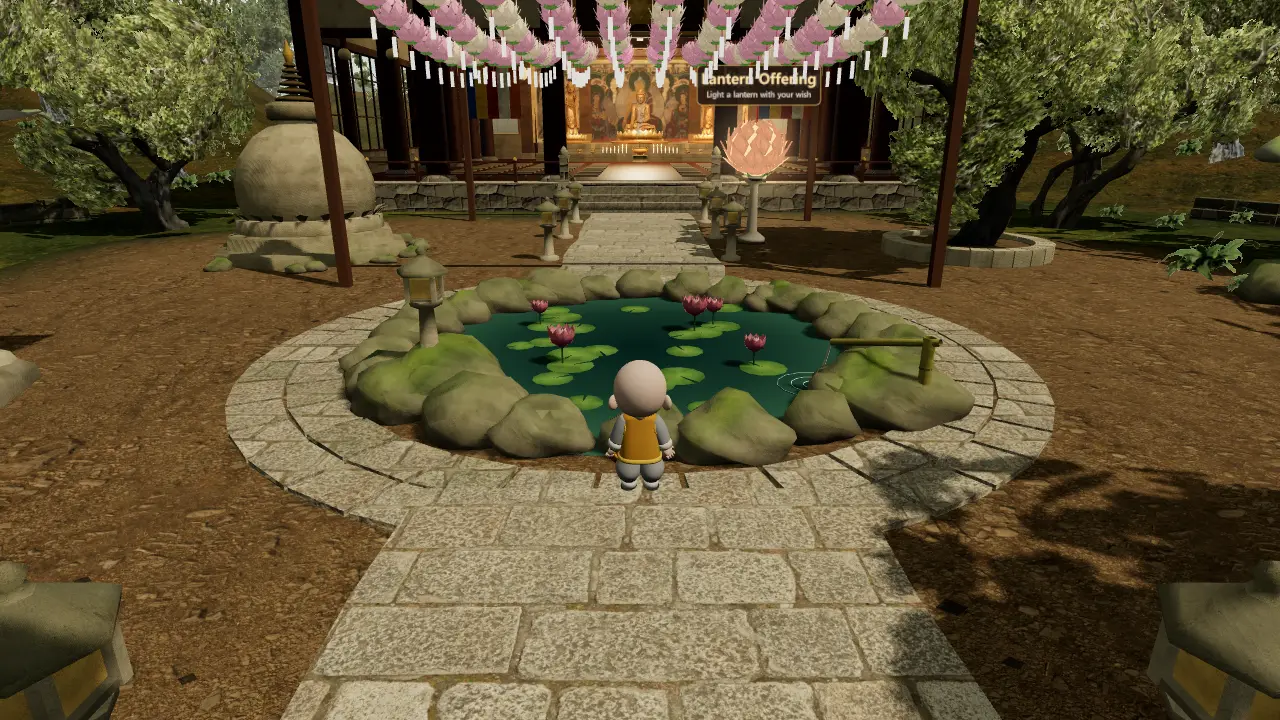
Buddhist symbols are images that point to the Buddha's life and teaching: the lotus for purity arising from difficulty, the bodhi tree for awakening, the stupa for the Buddha's presence, and the dharma wheel for his teaching. You will meet many of them just by walking through a temple. Here is what the most common ones mean.
The lotus
The lotus grows from the mud at the bottom of a pond and opens clean above the water. It is often read as a picture of a mind that can awaken in the middle of ordinary, difficult life. Buddhas are frequently shown seated on a lotus throne, and the paper lanterns at many temples take its shape.
The bodhi tree
The Buddha is said to have reached awakening while sitting under a fig tree at Bodh Gaya in India, a species now known as *Ficus religiosa*. Its heart-shaped leaf is widely used as a symbol, and many temples plant a bodhi tree in their grounds. Early Buddhist art sometimes showed the tree in place of the Buddha himself.
The stupa
A stupa began as a mound holding relics of the Buddha. Over time it took many forms: the bell-shaped chedi of Thailand, the stone and wooden pagodas of Korea, China and Japan, and the white stupas of Tibet. People show respect by walking around it clockwise.
The dharma wheel
The eight-spoked wheel, or *dharmachakra*, stands for the Buddha's teaching, set in motion with his first sermon. Its eight spokes are commonly linked with the Noble Eightfold Path.
The temple bell
Bells call people to practice and mark the hours. In East Asia, large bronze bells are struck from outside with a swinging log, and the long fading note is often used as a teaching in itself on impermanence. In some temples the bell is rung 108 times at the turn of the new year.
Joined palms and hand gestures
Joined palms, or *anjali*, are a greeting and a sign of respect. Buddha images hold other hand gestures called *mudra*. Touching the earth with the right hand recalls the moment of awakening, and a raised open palm signals freedom from fear.
Why early Buddhist art used symbols
For a long time, Buddhist artists often did not depict the Buddha in human form at all. Early Buddhist art, from around the 2nd century BCE to the 2nd century CE, was commonly (though not exclusively) what scholars call aniconic: instead of a human figure, it used signs. An empty seat, a tree, a wheel or a pair of footprints could stand for him. Good examples survive at sites such as Sanchi, Bharhut, Amaravati, Bodh Gaya and Sarnath.
According to one scholar's reading of those sites, three signs occur especially often, namely the bodhi tree, the dharma wheel and the stupa, suggesting that early Buddhist devotion focused on these three objects. This is a large part of the reason you still see them today, more than two thousand years later. The Buddhist Centre puts the larger point this way: Buddhism uses the language of symbols because its teachings communicate something that words and ideas cannot fully capture.
More about the stupa
Britannica describes the stupa as a commemorative monument, usually housing sacred relics associated with the Buddha or other saintly persons. Its rounded shape appears to come from pre-Buddhist burial mounds in India. The Great Stupa at Sanchi, built in the 2nd to 1st century BC, is the classic example: a circular base, a massive solid dome and an umbrella on top, surrounded by a railing and four gateways carved with stories.
As Buddhism spread, the same idea came to look very different. It became the bell-shaped *dagaba* of Sri Lanka, the terraced temple of Borobudur in Java, a range of forms in Tibet, and the multistoried pagodas of China, Korea and Japan. Yet Britannica points out that the core meaning survives in each: the relic at the centre is identified with the person or idea being remembered, and with the building itself. And the ways of honouring it are still similar: people walk around it clockwise.
More about the wheel
The wheel recalls the story of the Buddha's first sermon, in which he is said to have set the "wheel of dharma" in motion in the Deer Park at Isipatana. As The Buddhist Centre explains, its eight spokes stand for the eight limbs of the Eightfold Path, and the wheel also represents the universality and truth of the teaching. It is a particularly strong image in Theravada settings, and it is the wheel you may see on flags and on temple gates. A related image, the Wheel of Life, is a very different picture: a detailed diagram of existence used in Tibetan Buddhism and elsewhere.
The bodhi tree at Bodh Gaya
The place where the tree stands is still a working pilgrimage site. The Mahabodhi Temple Complex at Bodh Gaya, in the Indian state of Bihar, is a UNESCO World Heritage Site, inscribed in 2002. UNESCO records that the first temple there was built by the emperor Asoka in the 3rd century BC, and that the present temple dates from the 5th or 6th century. It is one of the earliest Buddhist temples built entirely in brick that still stands in India. So when a local temple plants a bodhi tree in its yard, it is making a link to a very real place.
Other symbols you may meet
Plenty of other signs are worth knowing, though we do not use them all in Sunava.
- Triratna, or three jewels: the Buddha, Dharma and Sangha, sometimes shown as three jewels or a three-pointed sign. They are what a three-bow practice honours. The triple umbrella above some stupas is linked with them too.
- Buddha footprints: carved footprints, sometimes with marks on the soles, recall his presence on earth. These are among the earliest signs.
- The vajra seat: the "diamond seat" at the place of awakening.
- Eight auspicious symbols: a well-known set, especially in Tibetan and other Himalayan art, that commonly includes a parasol, a pair of fish, a vase, a lotus, a conch, an endless knot, a banner and a wheel. Lists and readings can vary.
- Animals: elephants, lions, nagas and deer are widely depicted. The deer is linked to the Deer Park where the first sermon took place.
A note on the swastika
You may see a swastika on maps and temples across East and South Asia, particularly in Korea, Japan and Taiwan. In these settings it is an ancient Buddhist and Indian sign, with its roots far from European history, and it has nothing to do with Nazism, although many visitors are understandably startled to see one. If you see one at a temple, you can take it as a sign of a Buddhist site.
How to read a temple the next time you visit
The next time you are in a temple, try to pick up on a few things as you walk.
- Look down. Is there a lotus at the base of a statue or a column? Is there a carved lotus on the floor?
- Look at the hands of the statues. A hand touching the ground refers to the moment of awakening.
- Look up at the roofline. Are there lanterns or small bells? A fish-shaped chime, perhaps? Our page on the wooden fish explains why.
- Look outside. Is there a tower? A tree with a fence around it? Those are probably a stupa and a bodhi tree.
- Ask. Most people are happy to tell you the meaning of something in their temple, and the local reading may be nothing like what any book says.
Symbols and how to treat them
Because these images are meaningful to many people, a little care goes a long way. In some countries, notably Thailand and Sri Lanka, Buddha images are not treated as decoration, and using them on clothing or as tattoos can cause real offence. If you buy a small statue, place it somewhere clean and raised rather than on the floor. If you are unsure whether something is appropriate, ask someone from that tradition, who will usually be glad you did. A symbol stands for something people value, and treating it with respect is treating them with respect.
Where to see them at Sunava
Sunava is built from these shared symbols instead of copying any one national style. Here is a short walking route:
- Lotus pond: right in front of you where you begin.
- Paper lotus lanterns: strung above the path. You can light one.
- Stupa and bodhi tree: in the courtyard to the sides of the path.
- Bell pavilion: ring it once and listen to it fade.
- Main hall: a seated Buddha at the altar.
Different traditions read these symbols in their own ways, and this short list only scratches the surface. If one catches your interest, a local temple or a Buddhist teacher will be able to tell you far more.
Sources
- Stupa, Encyclopaedia Britannica
- Mahabodhi Temple Complex at Bodh Gaya, UNESCO World Heritage Centre
- Symbols, The Buddhist Centre
- Buddhist symbolism, Wikipedia