How to visit a Buddhist temple online from home
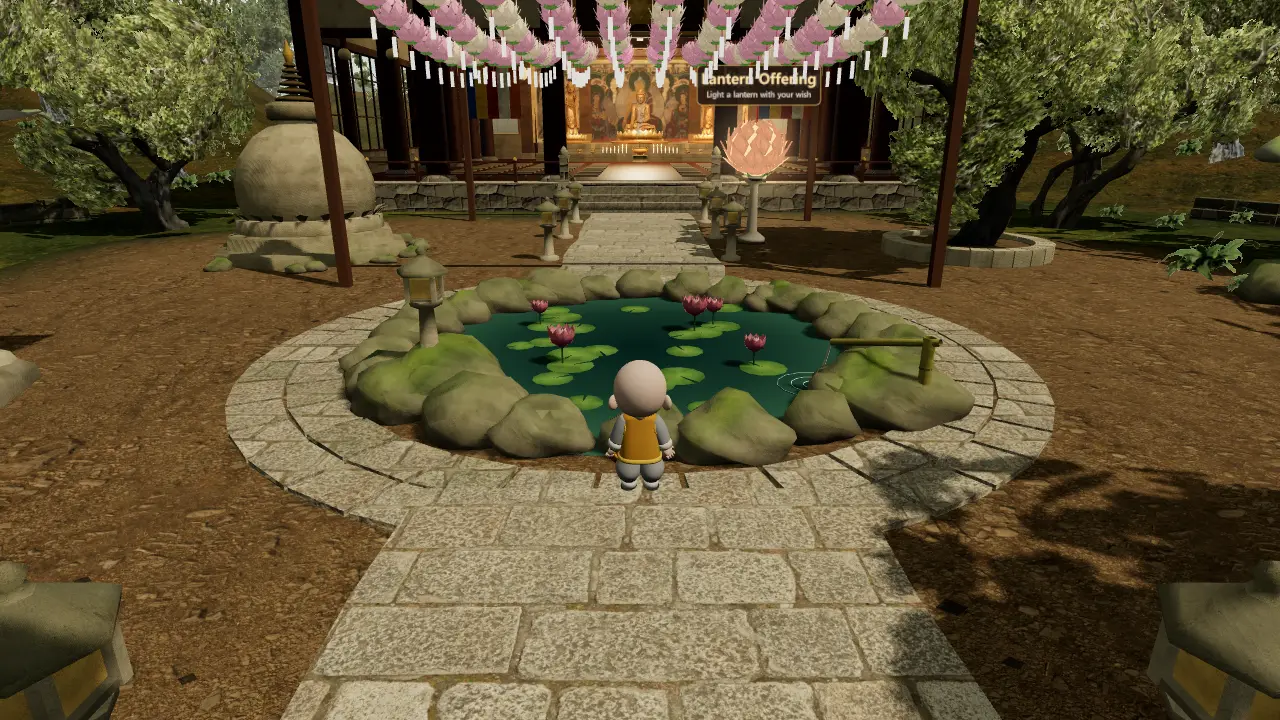
You can visit a Buddhist temple online from home by opening a virtual temple in your browser and walking in, with no app or travel. It will not replace standing in a real temple, and it does not try to. It helps when a temple is far away, when you are unwell, or when you have ten quiet minutes and want somewhere to spend them.
What people look for in an online temple
Most online temple options fall into three groups:
- Livestreams: real temples broadcast chanting or services. You watch at the times they set.
- Virtual tours: photos or video of a real place. You can look around, but usually alone.
- Walkable temples: a 3D space where you move, bow and make offerings, sometimes alongside others.
Sunava is the third kind. It is an original temple rather than a copy of a real one, built from what Buddhist traditions broadly share: a seated Buddha, a bodhi tree, a stupa, a lotus pond, a bell and lanterns.
A ten-minute visit, step by step
- Arrive slowly. Enter, and rather than rushing to the hall, walk once around the lotus pond.
- Ring the bell in the pavilion at the side of the courtyard, and listen until it fades.
- Light a lantern at the great lantern beside the path. If there is someone on your mind, you can write a wish for them.
- Go up to the main hall and make three bows before the altar.
- Sit on a cushion and start a five-minute meditation.
If you come back the next day, the people who were there will have changed, but the lanterns from the last 24 hours will still be burning, including yours.
Making it feel like more than a screen
What separates a visit from browsing is mostly what you do around it.
- Put your phone on silent first, so nothing interrupts you.
- Use headphones. The courtyard has forest sound and the bell carries.
- Decide in advance when you will leave, and leave when you said you would.
- Try coming at the same time each day. Six in the evening is a good choice, since that is when the evening sitting begins in your time zone.
Why temples started opening online
Going to a temple through a screen is newer than the temple, but it is no longer unusual. During the COVID-19 pandemic many communities had to find other ways to gather. Researchers at the Asia Research Institute of the National University of Singapore followed Chinese temples in Singapore through the 2020 restrictions, recording how they moved events onto the internet while their halls were closed or limited.
The change did not end when the doors reopened. Academic work on virtual pilgrimage and on digital Buddhist practice, including groups that meditate together online, treats these as forms of practice that deserve study in their own right, rather than as a temporary substitute. Scholars do not agree on what is gained and what is lost, and neither do teachers. What is clear is that many people now move between a physical temple and a digital one, and that plenty of them came to online practice because of distance, illness, caring duties or work hours.
How to choose the right kind of visit
The three kinds of online temple serve different needs. Asking what you actually want from the time usually settles it.
- If you want to hear a real community chant, choose a livestream. You receive a real service as it happens, with a real teacher. In exchange you follow its timetable, and you can only watch.
- If you are planning a trip or are curious about one place, choose a virtual tour. You see the actual architecture, which helps if you hope to go. Most tours do not let you do much beyond looking.
- If you want to do something with your body and attention, choose a walkable temple. You can move, bow, make an offering and sit. It suits a short visit at any hour, though it cannot give you a teacher or a real building.
These are not rivals. Someone might watch a service from their home temple on a Sunday and use a walkable temple for ten minutes on a weekday evening.
What an online visit cannot do
It is worth being plain about the limits, so that you do not expect the wrong things.
- There is no teacher. Sunava has no monks or nuns, gives no teachings, and cannot answer a question about your life or your practice. For that you need a person.
- There is no community in the full sense. You can share a space with strangers, but you cannot get to know them, since the temple has no chat. A local group offers friendship and mutual support that a quiet 3D courtyard does not.
- There are no ceremonies. Formal rites such as taking the precepts, and memorial services for someone who has died, belong to a real temple and its clergy.
- There is nothing to touch or smell. The cold of a stone floor, the smoke of real incense and the weight of a bronze bell are part of being there.
If any of these are what you are looking for, an online visit may be a good way to prepare, but it is not the destination.
Who an online visit tends to suit
Some situations come up again and again when people describe why they look for an online temple.
- You live far from any temple. In many places the nearest one is hours away, or belongs to a tradition you do not know.
- You are unwell, or caring for someone. It can be hard to leave home, and a visit that takes ten minutes and starts when you are ready can fit around that.
- You feel shy about going in person. Not knowing when to bow or where to stand stops many first visits. Trying the gestures privately can make the real door easier to walk through.
- You are away from home. People who have moved abroad sometimes want a familiar shape to their day, in their own language.
- You just want a calm place to be. You do not have to be a Buddhist, or to be planning to become one, to spend a few minutes in a quiet courtyard.
Visiting together when you are far apart
Sitting with someone can matter even when neither of you says a word. Because each Sunava room holds up to 100 people and every room is open to everyone, you can arrange to meet a friend or relative in another country.
- Enter and choose a name and a room. Rooms are numbered 1 to 10 and are the same in every language.
- Press the share button at the top of the screen and send the link.
- Your friend opens it, chooses their own name, and comes into the same room.
Agree on a time first, because the temple itself has no way of sending a message. Some families find that a small shared habit like this, such as lighting a lantern on a particular date, is a gentle way to stay in touch. Remember that the evening sitting follows each person's own clock, so two people in different time zones will not see it at the same moment. To everyone else, the temple simply looks as it always does.
Questions people often ask
Does it cost anything? No. Sunava is free to enter, and there is nothing to install and no account to create.
Do I need to be a Buddhist? No. Visitors of any faith or none are welcome. Sunava does not ask what you believe.
Can other people see what I write? No one can read your wish. Your lantern's wish stays on your own device. Others can see your character, the name you chose and the fact that a lantern is lit.
Do I have to use my real name? No. You can pick any nickname, as long as it is not abusive, or stay a visitor.
What happens to my offerings when I leave? They stay lit for 24 hours and other visitors can see them in every room, even after you have gone.
Does it work on a phone? Yes. It runs in the browser on phones and computers, and it lowers its quality on older devices. The visitor's guide has more on this.
Is an online temple visit "real" practice?
Buddhist teachers answer this differently, and it is fair to ask one. Sunava makes no claim that a visit earns merit or brings a particular result. It offers a calm place and familiar gestures, and what they mean to you is your own. If you live near a temple, it is still worth going in person, and our notes on temple etiquette will help on a first visit.
Sources
- Chinese Temples Go Online, Asia Research Institute, National University of Singapore
- Contextualising virtual pilgrimage in Buddhism, City University of Hong Kong
- Meditating Online 'Alone Together': Two Case Studies of Digital Buddhist Practice, by Jessica Marie Falcone, Hualin International Journal of Buddhist Studies