Lotus lantern offering: what it means and how to light one online
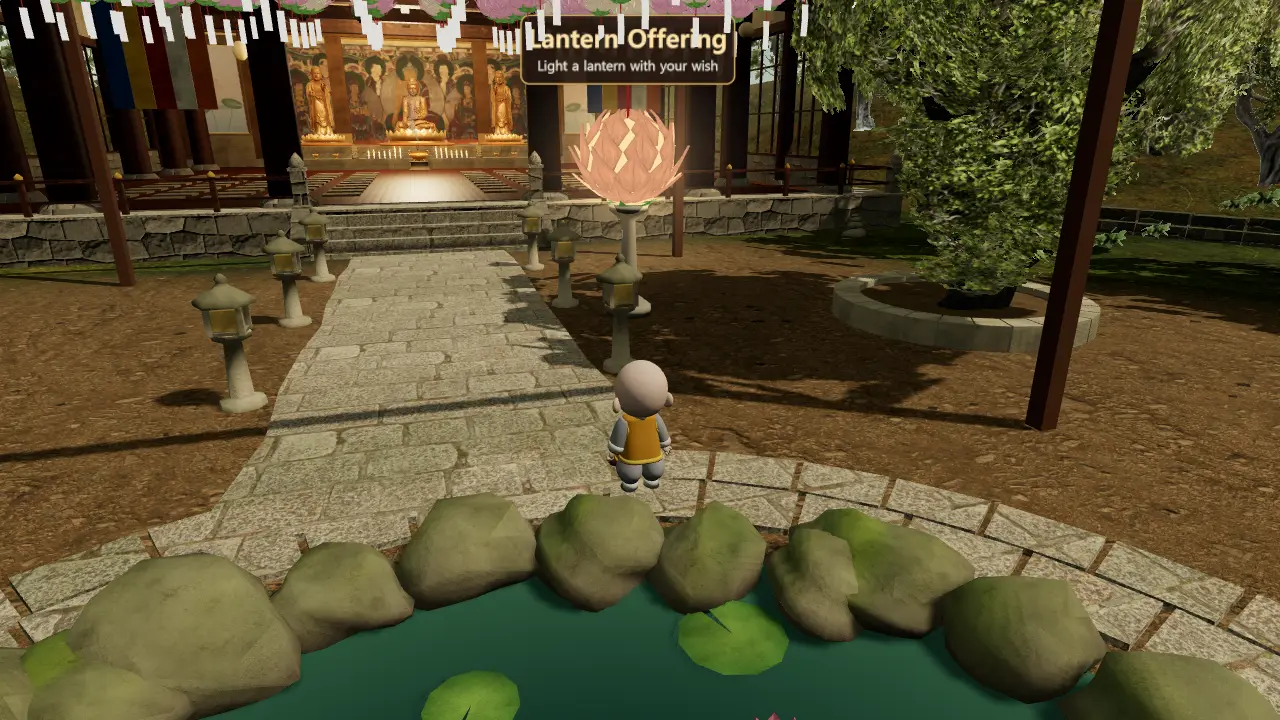
A lantern offering is the act of lighting a lamp before the Buddha as a gesture of respect and a wish for clear understanding. Light stands for wisdom that clears away ignorance, which is why lamps appear in Buddhist temples nearly everywhere. You can light one in person at a temple or festival, or online with a wish in a virtual temple.
The story of the poor woman's lamp
A widely told story describes a poor woman who wanted to offer a lamp to the Buddha. She sold her hair for a little oil and lit one small lamp among the many given by kings and wealthy donors. By morning the others had gone out, but hers still burned. The story is often used to say that an offering is measured by sincerity rather than size. In Korean temples it is remembered in the saying *binja-ildeung*, the one lamp of the poor.
Lantern traditions by country
- Korea: paper lotus lanterns, or *yeondeung*, are hung in temple courtyards and carried in parades for the Buddha's birthday. People often write a name or wish on a tag beneath the lantern.
- Japan: many temples hold *mando-e*, ceremonies with thousands of lamps, and visitors may offer a candle or lamp at the hall.
- Thailand: lanterns and floating offerings are part of festivals such as Yi Peng in the north and Loy Krathong, which have their own local histories.
- Vietnam: people release *hoa dang*, flower lanterns, on rivers during festivals and on the Buddha's birthday.
What to write on a lantern
A wish does not need to be grand, and it does not need to be about you. Common themes include:
- Good health for a parent or a friend
- Remembering someone who has died
- Calm before an exam, a move or a hard decision
- Thanks for something that went well
- A hope that others may be free from suffering
How to light a lantern online at Sunava
- Enter the temple and look for the great glowing lantern with a sign, to the right of the path past the lotus pond.
- Walk up to it and press the lantern button that appears.
- Choose a colour from the five offered.
- Light it. Your lantern joins the rows hanging over the courtyard.
- Write a wish if you like. It stays on your own device and is not sent to anyone.
Your lantern glows for 24 hours, and other visitors can see it, in any room. It stays lit after you leave, and each device can light one at a time.
What the older texts say
Retellings of the story vary, and it is worth knowing they do. A sutra preserved in the Tibetan canon and now translated by 84000 as *The City Beggar Woman* sets it in Śrāvastī, at Jeta's Grove. King Prasenajit offers a thousand lamps. A beggar woman, moved by this, gives what she can for a single lamp. In the sutra, the Buddha predicts her future awakening.
A Chinese Buddhist tradition knows a similar figure as a poor girl named Nanda, whose story appears in a sutra on the prophecy of King Ajatashatru. The Fo Guang Shan International Translation Center traces the practice of lamp offering to her, and draws the same lesson: merit depends on sincerity rather than on the size of the gift. Details such as the sale of her hair belong to later tellings and differ from place to place, so treat the story as a shared teaching rather than one fixed account.
Why light stands for wisdom
The image of light against darkness runs deep in Buddhist writing. The Fo Guang Shan page quotes the Flower Adornment Sutra: the lamp of wisdom can break through all forms of darkness. In this reading, the darkness is not the night but not seeing things clearly, and a lamp on an altar is a small reminder of what the practice aims at.
Theravada communities use a similar picture. Lighting a candle or oil lamp is commonly described as representing the light of wisdom in the darkness of ignorance, and that is the sense in which a lamp appears alongside flowers and incense in a daily offering. So although a lantern can carry a personal wish, its older meaning has less to do with getting something than with wanting to see clearly.
Korea's lantern festival and its UNESCO listing
Lanterns are perhaps best known outside Asia through Korea's Yeondeunghoe, the lantern lighting festival. In 2020, UNESCO added it to the Representative List of the Intangible Cultural Heritage of Humanity. UNESCO's description explains that the festival takes place across the country as the eighth day of the fourth lunar month, the Buddha's birthday, approaches. It starts with bathing an image of the baby Buddha, continues with a procession of people carrying lanterns, and ends with shared games. It began as a religious ritual, and it is now a national spring festival open to everyone.
If you happen to be in Korea in spring, it is well worth seeing. Many temples also hang lanterns in their courtyards in the weeks before the Buddha's birthday, and visitors can often sponsor one.
Lanterns on the water and in the sky
In Thailand, the full moon of the twelfth lunar month brings Loy Krathong, when people float small decorated offerings on rivers and canals. The Tourism Authority of Thailand lists regional forms such as Chiang Mai's Yi Peng and Sukhothai's candle festival among them. Recent official events have also promoted biodegradable krathong, since so many end up in the water. These festivals have their own local origins, and not all of their meaning is Buddhist.
If you take part in one, follow the local rules. Sky lanterns in particular are restricted in many places because of fire and aviation risks.
Choosing a colour
Sunava offers five lantern colours. Some temples and shops attach meanings to particular colours, but these vary, and no single system is shared across Buddhism. So we suggest choosing the one that feels right, or the one that reminds you of the person you have in mind. There is no wrong answer, and the choice has no effect on what the lantern means.
Writing a wish for someone else
Many people find it easier to write on someone else's behalf. A few simple phrasings, offered only as starting points:
- "May you rest well tonight."
- "May your treatment go gently."
- "I think of you often, and I am grateful."
- "May everyone who is afraid tonight find some ease."
If someone has died, you can simply write their name. For a lot of people a name is enough. Nobody else will read it in Sunava, because your wish stays on your own device. If you clear your browser or switch to another device, it will not follow you, so keep a copy somewhere if you want to remember your words.
Questions people often ask
Can I light a lantern for someone of another faith? Yes. Nothing in Sunava asks about anyone's beliefs, and a lantern simply marks your thoughts of them.
How long does the lantern last? In Sunava, 24 hours. After that it goes out, and you can light a new one. Temples have their own arrangements, which may run for days or a whole season.
Do I need to pay? Not in Sunava. Real temples usually ask for a donation for a lantern, which supports the temple, and that is a good reason to give.
Can other people see my lantern? They can see it glowing among the others. They cannot read your wish.
Lighting a lantern with someone else
A lantern can be a small thing to do together, even when you are apart. You might agree with a sister abroad to light one on your mother's birthday, or ask a friend going through a hard time to light one alongside yours. Because lanterns can be seen in every room, the two of you do not even need to be in the same one, although you can share a room link if you would like to walk the courtyard together.
When a real temple holds a lantern ceremony near you, consider going as well. Standing among hundreds of real lamps and the people who lit them is a very different experience from anything on a screen, and it may be the part you remember. If you are unsure whether visitors are welcome, a phone call or a look at the temple's website usually settles it, and most are glad to have you. Many also explain there how to sponsor a lamp for someone who cannot attend.
A note on what a lantern can do
Sunava does not claim that a lantern will make a wish come true. Lighting one is a way of pausing and holding someone in mind. If you would like to continue, candles and incense are waiting in the main hall.
Sources
- The City Beggar Woman (Toh 205), 84000: Translating the Words of the Buddha
- Lamp Offering, Fo Guang Shan International Translation Center
- Yeondeunghoe, lantern lighting festival in the Republic of Korea, UNESCO Intangible Cultural Heritage
- Loi Krathong Festival 2024, Tourism Authority of Thailand
- Pūjā (Buddhism), Wikipedia