The moktak (wooden fish): its meaning and how to play it online
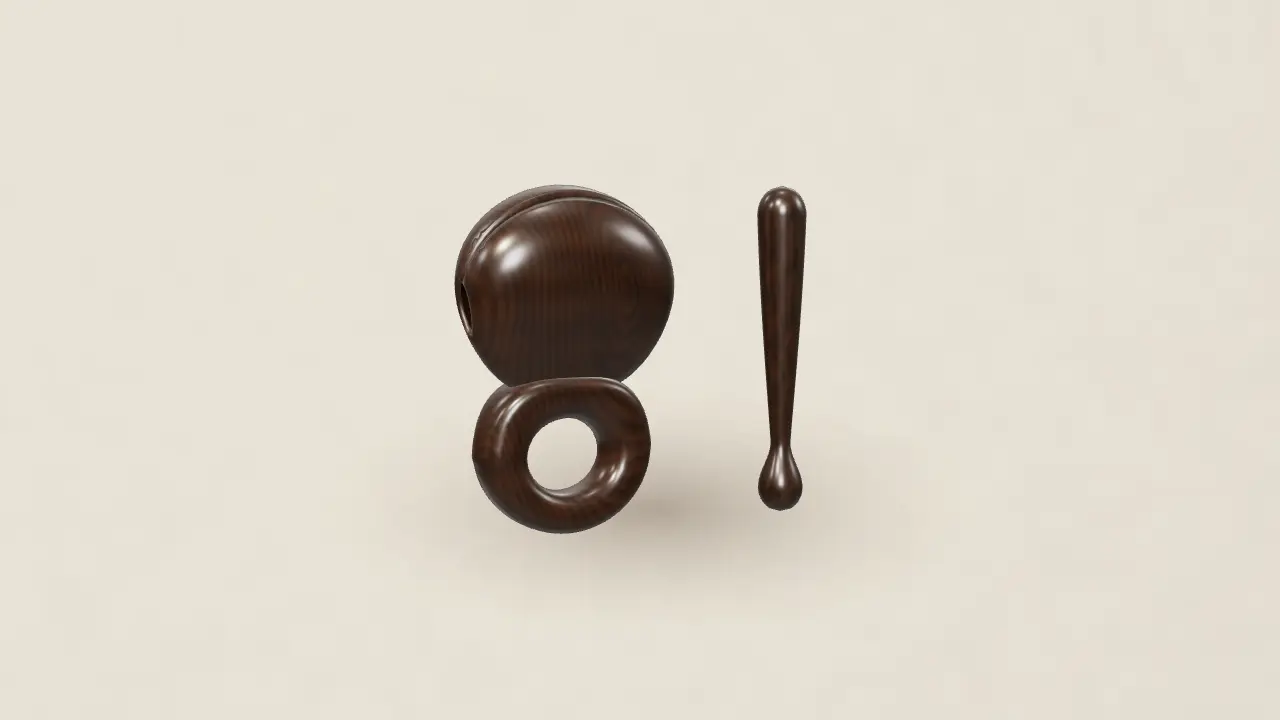
A moktak is a hollow wooden percussion instrument used in Buddhist temples to keep time during chanting. Its name in Korean means wooden fish, and it is known as *mokugyo* in Japan and *mo* in Vietnam. Its deep, round knock is one of the most recognisable sounds of East Asian temples.
Why a fish?
The usual explanation is that fish never close their eyes, so a fish stands for wakefulness, a reminder to stay attentive in practice. Some older temples hang a long wooden fish in a corridor, and the rounder handheld form developed from these. The carved shape often still has scales or a mouth, though many modern ones are nearly round.
What it does in a temple
- It keeps a shared rhythm, so a room of people can chant together.
- It marks the moments of a ceremony, such as bows or changes of chant.
- It gives one's attention an anchor. A steady beat makes it easier to notice when the mind has drifted.
The instrument belongs chiefly to Mahayana temples in Korea, China, Japan and Vietnam. It is less common in Theravada temples, such as those in Thailand, where you are more likely to hear a bell or chanting without a beat.
How it is played
The player holds a padded stick and strikes the hollow front, near the slit. The sound changes with where you hit it and how large the instrument is. A good beat is even and relaxed, and tempo is often set by the person leading.
How to play a moktak online
In the Sunava temple, press Moktak at the bottom of the screen. A wooden fish opens in front of you. Tap it to strike. A counter keeps track of your strikes, and you can turn the sound on or off in the corner.
You can use it however you like. Here are three suggestions:
- One breath, one strike. Tap on each out-breath for two minutes and let the sound fade fully before the next.
- Count to 108. Keep an even pace until the counter reaches 108.
- A short pause in your day. Ten slow strikes between tasks can make a clean break.
The stories told about its origin
No one can say for certain how the wooden fish came to be used in Buddhism. As the Korea Times has put it, the origin is unknown, and several stories have grown up to explain it.
The fish whose eyes never close
The simplest account is the one given above. A fish is thought to keep its eyes open day and night, and so it serves as a reminder to stay aware. Fish appear elsewhere in temples for the same reason, including in the metal clappers of wind chimes under the eaves. The wind sounds them to wake the mind, as a practitioner should be awake even in dreams.
The monk with a tree on his back
A second story tells of a monk who behaved badly during his life, and who was reborn as a fish with a tree growing out of its back. One day his former teacher was crossing a river, and the fish came to him in distress. The teacher saw what had happened and held a ceremony for him. That night the fish appeared to him in a dream, thanked him, and asked him to cut down the tree and carve it into a fish-shaped instrument, so that its story could serve as a lesson to others.
The baby in the lake
The Chogye International Zen Center of New York retells a third story, set in China. A high official's baby fell from a boat into a lake and could not be found. The official asked a monk to perform a ceremony, and the monk, after meditating, told him to go to the fish market the next morning and buy a very large fish. Inside it they found the baby, alive. In gratitude, the official wanted to help all fish, and the moktak was shaped like a fish with an open mouth and a hollow stomach. The centre's retelling says that when the sound rings out, all fish can hear it and awaken.
These are teaching stories, not history. Their very variety tells you how much people have wanted to explain this modest piece of wood.
Moktak, mokugyo, muyu, mõ: one instrument, several traditions
The wooden fish originated in China, and it is found today in Mahayana communities in China, Korea, Japan, Vietnam and beyond. It goes by many names: *muyu* in Chinese, *moktak* in Korean, *mokugyo* in Japanese and *mõ* in Vietnamese. Its uses differ somewhat from one school to another.
- Zen, Seon, Chan and Thiền: it helps to keep the rhythm during chanting.
- Pure Land: it accompanies the recitation of Amitabha Buddha's name, known as *nianfo* in Chinese and *nembutsu* in Japanese.
- Sizes: instruments range from about 15 centimetres, for individual and home use, to over a metre in large temples.
- Placement: in Chinese temples, a wooden fish is often placed on the left of the altar beside a bowl-shaped bell, its metal counterpart.
The sound has a practical side as well. The Korea Times notes that such instruments can serve as non-verbal signals, keeping talk to a minimum during meditation and other formal proceedings.
What to listen for in a temple
If you visit a temple during chanting, try paying attention to the moktak alone for a few minutes. You may notice a few things:
- The pace often changes. Many chants begin slowly and pick up speed gradually, and the moktak is often what sets this.
- A roll or a pattern may have a meaning. A sudden roll or a set of strokes might signal a change, a bow or the end of a section.
- Other sounds come in around it. A bell or a metal bowl may mark another layer of the structure.
Hearing this adds a lot to a ceremony, even if you don't understand the words. It may also be a good place to rest your mind, if chanting in another language feels strange.
If you would like one at home
Handheld moktaks are sold in temple shops and online. They are usually carved from a single hollowed block, and a hardwood gives a clearer, deeper sound. A few things are useful to know:
- It carries. Even a small moktak can be heard through walls, so think of your neighbours. A soft cushion underneath, along with a gentle stroke, can reduce it.
- Let it rest. Many people keep theirs on a small cushion on a clean surface, with its stick beside it.
- Learn from someone if you can. Temples often have their own ways of playing, and a brief lesson teaches more than any description.
If that sounds like more than you want, an app or a website does the job of a simple practice with no noise problem. You can turn the sound down in Sunava, or use headphones.
Why a repetitive sound can be calming
Much of what makes the moktak useful is that it is plain and very regular. It gives you one thing to come back to. This is not a special effect of the wood. Any steady rhythm can do it, and many cultures have some form of this. Sunava makes no claim that striking a virtual moktak has any religious merit or health benefit, but a few slow minutes spent on one simple sound can be a pleasant break for its own sake.
Questions people often ask
Do I have to be a Buddhist to play one? No one will ask in Sunava. In a real temple, the instruments in a hall are for ceremony, so please don't touch them unless invited to.
How fast should I go? Slowly enough that you can feel each one. If you are chanting, the pace of the chant decides this. If you aren't, one strike per breath is an easy default.
Why does my counter go to 108? You can keep striking past that, but 108 is a traditional count across Buddhist practice. See why mala beads have 108.
Is it the same as a temple block in an orchestra? They are related. Western percussionists use a set of tuned blocks that developed from this instrument, sometimes called Chinese or Korean blocks.
A two-minute rhythm exercise
To try this right now, choose a slow pace, and strike once at the start of each out-breath. Don't change your breathing to fit the sound. Let the sound follow the breath. After ten strikes, stop, and listen to the quiet for as long as it takes to take three breaths. That is the entire exercise.
Hear it in the evening
The moktak is also part of Sunava's evening sitting, held at 6 pm in your time zone. A few strokes of the wooden fish and a singing bowl open and close the 20 minutes. See the visitor's guide for how to join, or read about mala beads, another simple tool for keeping count.
Sources
- Origins of the Moktak, Chogye International Zen Center of New York
- Wooden fish, gongs and wind chimes: symbols of Buddhist cultivation, The Korea Times
- Wooden fish, Wikipedia