How to use mala beads: Buddhist prayer beads explained
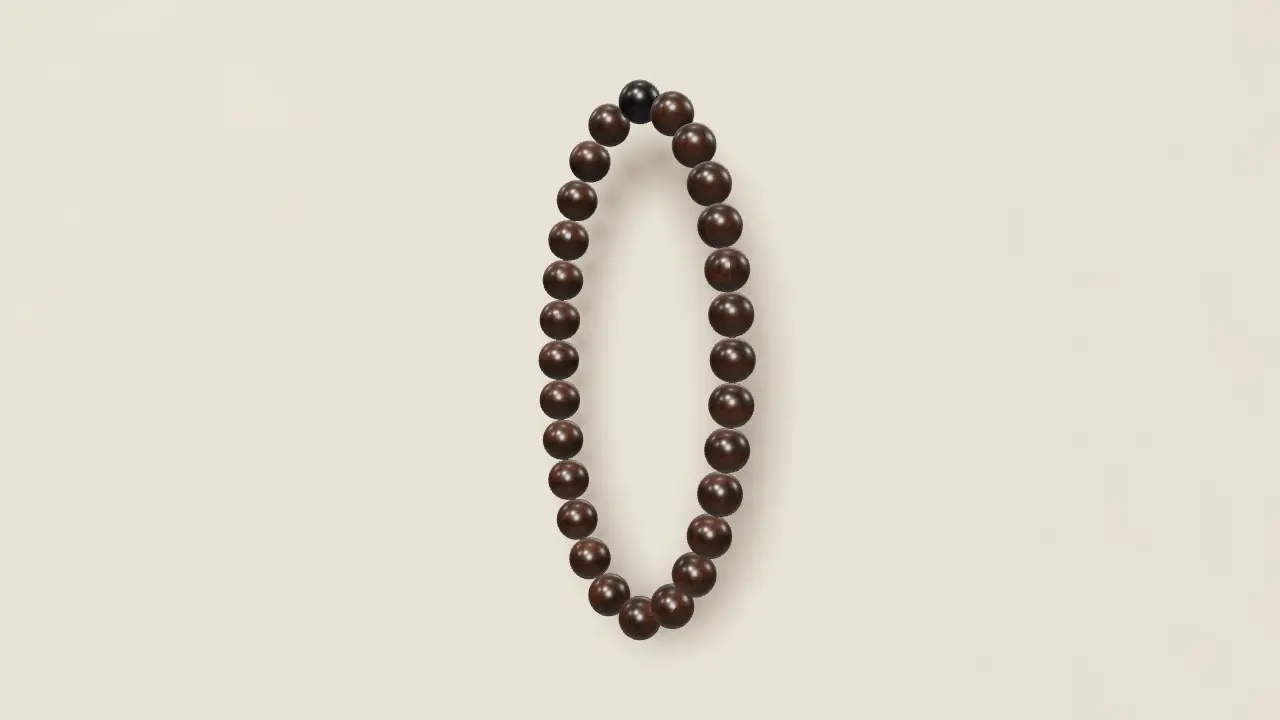
To use mala beads, hold the string in one hand and move one bead at a time between your thumb and finger, saying a phrase or taking a breath with each bead. A mala is a Buddhist string of beads for keeping count, so your attention can rest on the practice rather than the number. A full mala commonly has 108 beads.
Why 108 beads?
The number is usually linked to the 108 afflictions of the mind. A common explanation multiplies the six senses by the kinds of feeling and by past, present and future, though there are several versions of the sum. Shorter malas of 54 or 27 beads, half and a quarter of 108, are common as well, especially as wrist malas.
The parts of a mala
- Beads: often wood, seed or stone.
- Head bead: a larger bead that marks the start and end of the circle. It is called the guru bead in some traditions.
- Tassel or cord: a finish that varies by tradition, often with a meaning of its own.
How to use a mala, step by step
- Sit comfortably and take the mala in one hand, commonly the right.
- Start at the bead next to the head bead. Hold it between your thumb and middle finger, or thumb and index finger, depending on your tradition.
- Take one breath or say one phrase. Some people recite the Buddha's name or a mantra, and others simply count breaths.
- Move to the next bead by drawing it toward you with your thumb.
- When you reach the head bead, stop. Many practitioners don't cross it. They turn the mala around and go back the other way.
What to say
Practice differs by tradition. People in Pure Land schools often recite the name of Amitabha Buddha. In Tibetan Buddhism, *Om Mani Padme Hum* is well known. In Thailand, many people recite *Buddho*. If you have no tradition, a silent count of breaths is a perfectly good way to begin.
Looking after a mala
Many people keep a mala somewhere clean, and don't leave it on the floor or wear it as simple jewellery in a temple. Customs vary, but treating it with care is common everywhere. If you are given one by a teacher, it is fine to ask how they use theirs.
Where malas come from
The word *mala* is Sanskrit for garland, and strings of beads are used in several Indian religions as well as in Buddhism, including Hinduism, Jainism and Sikhism. The specific origin is unknown. Similar tools exist much further away too, such as the Islamic *misbaha* and the Christian rosary. Counting on beads seems to answer a very general human need.
Prayer beads do not appear in the earliest Buddhist scriptures, the Agamas and Nikayas. They enter Buddhist texts later, and they were in use in China by around the 7th century. An article in *Tricycle* retells what it calls the earliest tale of Buddhist mala practice: a king troubled by the worries of ruling asks the Buddha for an easier way to practise, and the Buddha tells him to string 108 bodhi seeds and count one with each recitation of the three refuges. In other words, the practice was first described for a layperson who could not leave daily life behind, and only later taken up by monks too. The article's author adds a wry observation of his own, which is that all beads are, at some level, worry beads.
Why the numbers differ
While 108 is the usual full count, you will see other numbers in practice.
- 108: the common full mala in many traditions. There is usually one additional bead, the head or guru bead, that is not counted.
- 54 and 27: half and a quarter of 108, convenient for shorter practice or for wearing on the wrist.
- 18: a small hand mala found in some traditions.
- 111: in some Tibetan practice, a few additional recitations are often added to make up for any mistakes.
A shorter mala does not make the practice lesser. If you are using a short one, you can simply go around more than once.
Beads by country
The tool has many names and styles. A few examples will help you recognise them.
- Korea: called *yeomju*. Temples sometimes offer bead-making as a visitor activity, and Korean templestay programmes list it among their activities.
- Japan: called *juzu* or *nenju*. Different schools have their own shapes, and many Japanese Buddhists carry a small juzu to funerals and memorial services.
- Tibetan traditions: malas often have counters on small side strings that keep track of the number of completed rounds, and they may be used for very large counts over many years.
- Thailand and other Theravada countries: beads are used, although not by everyone. Many practitioners recite *Buddho* with the breath, with or without beads.
- Vietnam: called *tràng hạt*, and frequently used with reciting Amitabha Buddha's name.
Choosing your first mala
You do not need one to practise, but if you would like to own one, keep these in mind:
- Material. Malas have traditionally been made of wood, seeds, stone, bone and metal, and today also plastic and glass. Wood and seeds are light and quiet. Stone is heavy and cool to the touch.
- Size. A wrist mala with 27 beads is easy to carry. A full 108 is easier to use when seated. Move the beads in your fingers before you buy, if you can.
- Source. You do not need an expensive one. If you visit a temple, its shop is often a good place to buy one, and your purchase may help support it.
- Claims. Be careful with sellers who promise wealth, healing or luck from a particular stone. Those claims are not part of mainstream Buddhist teaching, and no bead is going to do that.
If your hands are stiff or you have a condition such as arthritis, larger beads are easier to handle, and a touchscreen version may be more comfortable.
Three ways to practise with beads
If you have no tradition to guide you, here are some simple options. None of them needs any belief.
- Refuge count. Follow the old story: with each bead, silently say "I take refuge in the Buddha, the Dharma and the Sangha", in your own language.
- Breath count. One breath, one bead. Going through 27 beads takes about five minutes at a relaxed pace. This works well with five-minute meditation.
- Bow count. Use one bead for each bow. You will not lose your place, and you can pause without having to start again.
When the beads become a habit
Most people use a mala at a set time, such as in the morning or before bed. But some keep a short one in a pocket and turn it during a long wait or a difficult moment. Moving something small in your fingers can give you a steady thing to attend to, and many people find that helpful. It is not a cure for anxiety, and if worry is getting in the way of your life, it is worth speaking to a professional.
Questions people often ask
Can non-Buddhists wear a mala? Many do, and it isn't forbidden. But remember that for many people it is a religious object. Treat it with care, and take it off in places where it may be out of keeping, or ask if you are unsure.
What if a mala breaks? Restring it if you can, or get it repaired. Many people simply keep the beads somewhere clean. No bad luck is attached to it in mainstream teaching.
Why don't people cross the head bead? It is commonly treated with respect as a marker, and turning back also keeps you from counting past the end without noticing. Customs differ, so do not worry if you were taught differently.
Is an online mala a real mala? It counts the same numbers, but it is obviously not the same as a physical object. It suits a moment when you don't have one nearby.
Keeping count without losing the point
It is easy to start caring more about the number than about what you are doing. If you find yourself rushing to finish a round, slow down, or do fewer beads. A single unhurried round of 27 is worth more to most people than a hurried 108. Equally, if you miss a day, you have nothing to make up. Many practitioners keep daily counts for years, while others never count anything at all, and both are recognised ways of practising. It might help to think of the beads the way you would think of a walking stick. They help you to go on, and it's the walk that matters.
Counting beads online
No mala at hand? In the Sunava temple, press Beads at the bottom of the screen and a string of beads appears. Slide your finger or mouse to move one bead at a time. Choose a goal of 27, 54 or 108. It is also useful for keeping count of bows. For another rhythm, try the moktak.
Sources
- Mala Beads: History, Tricycle: The Buddhist Review
- Japamala, Wikipedia
- Buddhist prayer beads, Encyclopedia of Buddhism
- Templestay, Cultural Corps of Korean Buddhism