Walking meditation: how to do it, step by step
Walking meditation is the practice of walking slowly and paying close attention to the walking itself. You pick a short path, walk back and forth along it, and keep your attention on your feet, your steps or your breath. When your mind wanders, you notice that and come back. You can learn the basic form in about ten minutes, and you need no special equipment.
What walking meditation is
Most of the time we walk to get somewhere. Our attention is already at the destination, and our feet look after themselves. In walking meditation the aim reverses. You are not going anywhere, so the walking becomes the thing you pay attention to.
The idea is old. In the Satipatthana Sutta (Majjhima Nikaya 10), in Thanissaro Bhikkhu's translation, the teaching on the body says: "Furthermore, when walking, the monk discerns, 'I am walking.'" The same passage continues with standing, sitting and lying down, and ends: "Or however his body is disposed, that is how he discerns it." The instruction is very plain. You know that you are walking while you are walking.
Sayadaw U Silananda, writing on the benefits of walking meditation, calls it integral to the continuous development of mindfulness. He also says it is as valid a practice as sitting meditation. Traditions differ on how it is done and how much weight it carries, so treat what follows as one clear starting point, not the only way.
Before you start
You need very little.
- A short path. The Tricycle guide to walking meditation suggests a private spot about 10 to 20 feet long, such as a secluded outdoor area or an empty hallway. It recommends a place where you will not feel self-conscious.
- A timer. The same guide suggests a timer with a gentle sound, so you do not need to check the time. If you are new, set a short time. Five or ten minutes is enough for a first try, and you can lengthen it later.
- Comfortable footwear, or none. Choose whatever lets you feel your feet and keeps you safe on the surface you have chosen.
Walking in a straight line over a short distance is a feature, not a limit. A short path means you do not have to decide where to go. You turn around at the end, and each turn is a small chance to begin again.
How to do walking meditation, step by step
These steps follow the guidance gathered in the Tricycle article, which draws on several teachers.
- Stand still at one end of the path. Take a moment to feel your whole body standing. Then let your attention settle on the soles of your feet.
- Place your hands. The Thai teacher Ajahn Chah suggests clasping your hands in front of you, with "a very slight tension that compels the mind to be attentive." The Zen teacher Hakuun Yasutani places the right fist, thumb inside, against the chest and covers it with the left palm, keeping the forearms level. Pick whichever feels natural and steady.
- Keep your body upright. Hold your back straight without stiffness, and let your arms be steady.
- Rest your gaze. The guide advises resting your eyes on a point about two yards ahead and keeping them open for balance. You are not watching your feet. You are letting your eyes be quiet.
- Walk at a comfortable pace. Start with a normal stroll, then slow down if you can. The meditation teacher Sylvia Boorstein says to select the speed at which you are most likely to maintain attention. Thich Nhat Hanh recommends walking straight ahead with dignity and calm, placing each step deliberately.
- Choose one anchor for your attention. See the next section.
- Turn at the end. Stop at the end of the path, pause, and turn around. Then walk back. Continue back and forth until the timer sounds.
Choose an anchor for your attention
Teachers offer several places to rest your attention. Pick one, and stay with it for the whole session.
- The feet. Notice the pressure of each foot on the ground, and whether the ground feels soft or hard.
- The parts of each step. Notice lifting, moving and placing, one after the other.
- The breath. Count your breath or link it with your steps.
- A repeated word. Chah uses the word "Buddho," repeated silently.
You do not need to use all of these. If you try to watch everything at once, you will probably end up watching nothing. One anchor is enough.
Naming your steps, in stages
Sayadaw U Silananda describes a way to build up in stages, and it is a good fit for beginners.
- Beginner. Note only the act of stepping, silently, as "stepping, stepping" or "left, right." Walk slower than you would normally.
- After a few hours or a day or two. Note two stages, "stepping, putting down."
- Later. Note three stages: lifting the foot, moving it forward and putting it down.
- Still later. Note four stages: "lifting, moving forward, putting down, pressing the ground."
Throughout, he advises paying close attention to each movement. He adds that slowing down should happen naturally as your attention sharpens, and that you should not force it. If you find yourself creeping along in a strained way, ease back to a pace that feels like walking.
When your mind wanders
It will. Wandering is not a sign that you are doing it wrong. Noticing is the practice. The sources offer a few simple responses:
- Stand still and come back to the body. Chah suggests stopping, standing still and bringing your attention back to the body.
- Return to the breath. If the mind keeps drifting, Chah says to bring your attention back to your breath.
- Begin again from the last clear step. Boorstein suggests noticing the distraction and starting again from your last clear step.
- Let thoughts come and go. Jon Kabat-Zinn's approach is to treat thoughts and feelings as they arise, then return to the step itself.
A gentle manner helps. There is no score to keep, and no step is wasted because your mind was elsewhere. The moment you realise you were lost is the moment you are back.
How long should you walk?
Boorstein suggests starting with thirty minutes, which may be a lot for a first attempt. If that sounds like too much, begin with five or ten minutes and add a little over time. Yasutani gives a different use: he recommends at least five minutes of walking after each sitting period of twenty to thirty minutes. That treats walking as a bridge between two periods of sitting.
Chah also gives advice about changing position. Change position when you are physically tired, not at the first urge. First ask yourself whether the urge comes from physical fatigue, restlessness or laziness. It is a useful question for any practice, and it keeps you from quitting on a passing mood.
Walking meditation and sitting meditation
Walking and sitting are not rivals. They train the same skill: knowing what is happening while it happens. The Satipatthana Sutta places walking beside standing, sitting and lying down, as four postures in which you can know what the body is doing.
If you are new to sitting, the guide to five-minute meditation for beginners is a gentle place to begin. You can alternate if you like: sit for a while, walk for a few minutes, then sit again.
Walking safely and comfortably
- Check the ground. Remove anything you could trip on, and choose a surface that is level.
- Mind your knees and balance. If you have trouble with balance, stay near a wall or a chair, or keep your steps small. You can also do the practice sitting, by giving your attention to the breath. It is fine to adapt.
- Do not force a slow pace. A natural slowing is better than an exaggerated one.
- This is not medical care. Walking meditation is not a treatment for any condition. If something difficult comes up, stop, and consider talking with a professional.
Try walking meditation in the Sunava online temple
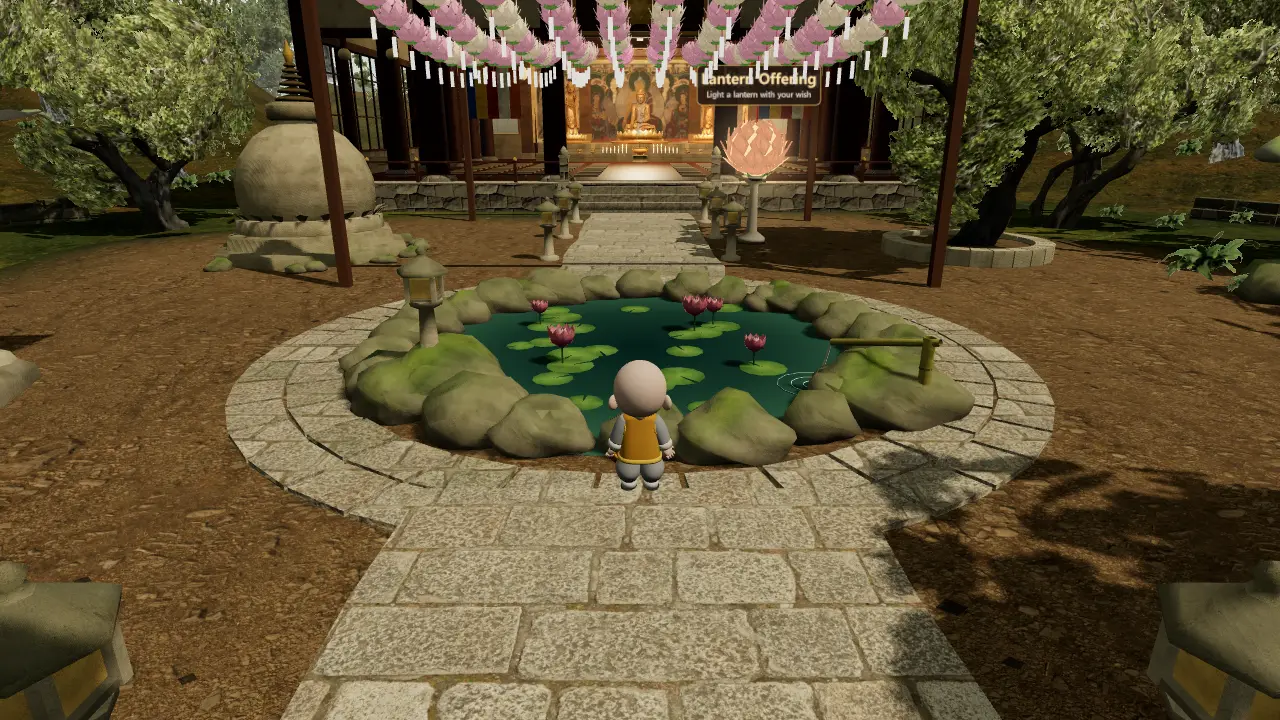
You can practise the same attention in Sunava, the online Buddhist temple. Sunava is an original space, not a model of any real temple, and it is not affiliated with any temple or order. It has no walking-meditation program. What it gives you is a quiet place to walk, which you can use as your path.
- Enter the temple and start in the courtyard, by the lotus pond.
- Follow the stone path toward the steps of the main hall. On a phone, push the circle at the bottom left. On a computer, click the ground or drag the circle.
- Move in small, slow pushes, and notice how the scene changes with each one.
- Walk up to the bell at the side of the courtyard, or into the hall, and pause there.
- If you want company in stillness, sit in the hall with the Sit button, or press Meditate for a quiet timer of 3, 5 or 10 minutes.
Each evening at 6 pm in your time zone, the lights go down for a shared 20-minute sitting. You can join for all of it or only part. Our guide to temple etiquette is a helpful read if you plan to visit a temple in person afterwards. The online temple visit page explains what the experience is like.
When you walk in the browser, your hands are on a screen, so the practice is about attention more than posture. Try watching your thumb move the circle with the same care you would give a footstep. Then, when you are away from the screen, do the real thing in a hallway or a garden.
Frequently asked questions
Is walking meditation the same as a mindful walk outdoors? They are close. In a mindful walk you go somewhere and stay aware as you move. In the formal practice described here you walk a short path back and forth, and the walking is the whole point.
Should I look at my feet? The Tricycle guide advises resting the eyes on a point about two yards ahead, open for balance. Looking down at your feet tends to make people hunch.
Do I need to walk very slowly? No. Start at a normal stroll and slow down if you can. Silananda says slowing should come naturally as attention sharpens, not by force.
Can I do it indoors? Yes. An empty hallway is one of the places the Tricycle guide names, and a path of 10 to 20 feet is enough.
Does it replace sitting? Silananda calls it as valid a practice as sitting. The two can be combined, as Yasutani's advice to walk after a sitting period shows.
Which tradition does this come from? The text quoted here is the Satipatthana Sutta, and the practical guidance comes from several teachers. Practices and customs differ between traditions, so follow your own teacher if you have one.
Sources
- Satipatthana Sutta: Frames of Reference (MN 10), Access to Insight
- The Benefits of Walking Meditation, Sayadaw U Silananda, Buddhist Publication Society, via Access to Insight
- Walking Meditation Instructions: Mindfulness on the Move, Tricycle